

Survival through Quality
PRODUCT CENTER
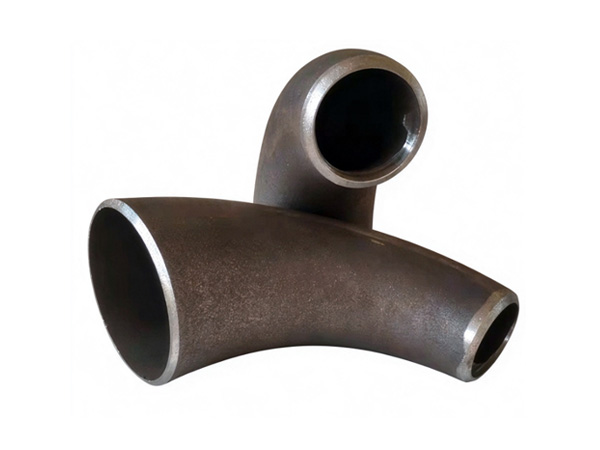
Reducing elbow
What is a Reducing Elbow?
A reducing elbow combines a 90-degree direction change with a reduction in pipe size in one fitting. One end matches the larger pipe size while the other end matches a smaller size, allowing flow to turn and reduce in diameter simultaneously. This eliminates the need for a separate elbow and reducer, saving space, welding time, and material cost in piping systems where both functions are needed.
Standards and Specifications
Reducing elbows are manufactured to ASME B16.9 and ASME B16.28, with one end sized to the larger run and the other to the smaller branch. They also conform to MSS SP-75 and ASTM A234. Common combinations reduce by one or two standard sizes (for example, NPS 4 by NPS 3 or NPS 6 by NPS 4). Wall thickness at the larger end matches the run pipe; the smaller end is selected to match the downstream pipe schedule.
Materials and Grades
Carbon steel A234 WPB is standard for general service. Stainless steel 304/304L and 316/316L provide corrosion resistance for chemical and marine applications. Alloy steel WP11, WP22, and WP91 grades handle high-temperature power and refinery service. Low-temperature A420 WPL6 is available for cryogenic piping. All material is traceable by heat number.
Pressure and Design Considerations
Reducing elbows are rated based on the wall thickness at each end and the pressure class of the piping system. The transition zone between the two diameters is designed to minimize turbulence and flow separation. The larger end carries the full run pressure, while the smaller end matches the downstream pipe rating. Each fitting is hydrostatically tested after forming.
Applications
Reducing elbows are used in pump and compressor discharges, branch take-offs, equipment connections where the nozzle size differs from the main line, and process piping where flow velocity increases after a turn. They are common in oil and gas production, refineries, chemical plants, power generation, and water treatment systems.
Advantages
Combining the elbow and reducer in one fitting reduces the number of welds, simplifies installation, and saves space compared with separate components. The smooth transition reduces turbulence and pressure drop compared with an abrupt elbow followed by a reducer. Fewer welds mean fewer potential leak points and lower inspection costs.
Installation Guidelines
Bevel both ends to match the respective pipe sizes. Align the larger end with the run pipe and the smaller end with the downstream pipe. Tack weld both joints, then complete full-penetration butt welds with matching filler metal. Apply preheat and post-weld heat treatment as required. Provide proper support at the transition to handle weight and pressure thrust.
Quality Assurance
Each reducing elbow is marked with both sizes, grade, heat number, wall thickness, and manufacturer's stamp. Inspection includes dimensional checks at both ends, wall thickness verification, and NDE when specified. Material test certificates to EN 10204 3.1 are provided. Fittings are coated with rust-preventive oil and bevel ends are protected for shipping.