

Survival through Quality
PRODUCT CENTER
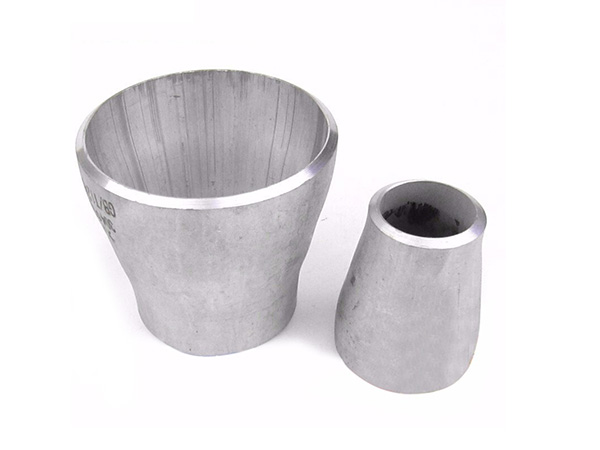
Reducer
What is a Reducer?
A reducer is a piping fitting that connects two pipes of different diameters, allowing flow to transition from a larger line to a smaller one. It is available in concentric and eccentric configurations. The concentric reducer has a straight centerline, while the eccentric reducer has one flat side used to maintain elevation on horizontal lines. Reducers are essential for matching equipment nozzle sizes to process piping.
Standards and Specifications
Reducers are manufactured to ASME B16.9 and ASME B16.28, conforming to MSS SP-75 and ASTM A234. Sizes range from NPS 1/2 by NPS 1/4 to NPS 48 by NPS 40, with wall schedules from SCH 10 to SCH XXS. Concentric and eccentric patterns are available. Ends are beveled for butt welding. The taper length follows standard dimensions to minimize flow turbulence.
Materials and Grades
Carbon steel A234 WPB is the standard grade for general service. Stainless steel 304/304L and 316/316L provide corrosion resistance for chemical and marine applications. Alloy steel WP11, WP22, and WP91 grades handle high-temperature refinery and power service. Low-temperature A420 WPL6 is available for cryogenic piping. All material is traceable by heat number.
Pressure and Temperature Ratings
Reducers are rated for pressure classes 150 through 2500. The gradual taper minimizes turbulence, erosion, and flow separation at the diameter change. Temperature range depends on material: carbon steel to 425 degrees Celsius, alloy steel to 600 degrees Celsius, stainless steel from cryogenic to 800 degrees Celsius. Each reducer is hydrostatically tested.
Applications
Reducers are used in pump suction and discharge lines, equipment nozzle connections, process header size transitions, fuel gas systems, and compressor piping. Concentric reducers are used on vertical piping; eccentric reducers are used on horizontal lines to prevent liquid or vapor pockets from forming.
Advantages
The smooth taper provides a gradual flow transition with low pressure drop and minimal erosion. Butt-welded construction creates a permanent, leak-free joint. Standard dimensions ensure interchangeability. Reducers are available in a complete range of materials and sizes to match any piping specification.
Installation Guidelines
Bevel both ends, align the reducer, and tack weld. Complete the two butt welds using GTAW root and SMAW fill passes with matching filler metal. For thick-wall or alloy materials, apply preheat and post-weld heat treatment. On horizontal liquid lines, install eccentric reducers flat-side-down; on gas lines, flat-side-up.
Quality Assurance
Each reducer is marked with both sizes, grade, heat number, wall thickness, and manufacturer's stamp. Inspection includes dimensional checks at both ends, wall thickness measurement, visual examination, and NDE when specified. Material test certificates to EN 10204 3.1 are provided. Reducers are coated with rust-preventive oil and bevel ends are capped for shipping.