

Survival through Quality
PRODUCT CENTER
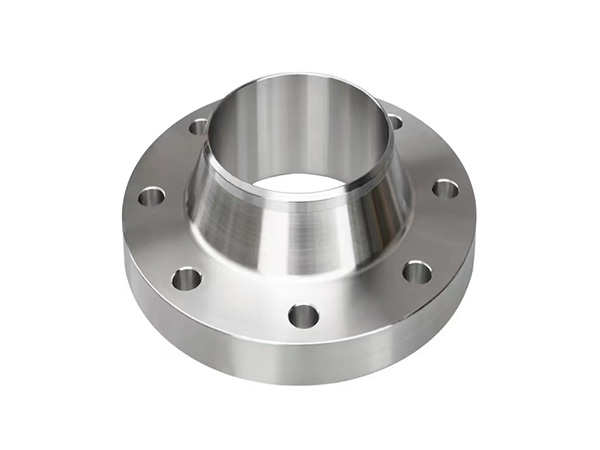
Weld Neck Flange
What is a Weld Neck Flange?
A weld neck flange (WNF) features a long tapered hub that is butt-welded to the pipe. The tapered design transfers stress from the flange to the pipe itself, making it the strongest and most reliable flange type for high-pressure, high-temperature, and cyclic service. Weld neck flanges are specified for critical piping where leak-tightness and long-term performance are essential.
Standards and Specifications
Weld neck flanges are manufactured to ASME B16.5 and ASME B16.47, conforming to EN 1092 Type 11 and DIN standards. Sizes range from NPS 1/2 to NPS 48, with pressure classes 150, 300, 600, 900, 1500, and 2500. The bore matches the pipe inner diameter exactly for smooth flow. Faces include raised face (RF), flat face (FF), ring type joint (RTJ), and tongue-and-groove for high-pressure sealing.
Materials and Grades
Carbon steel A105 and Q235B are standard for general high-pressure service. Stainless steel F304/F304L and F316/F316L provide corrosion resistance. Alloy steel F11, F22, and F91 grades are used in high-temperature refinery and power service. Low-temperature grade A350 LF2 handles cryogenic and refrigeration piping. Duplex and super duplex stainless steels are available for severe corrosive environments.
Pressure and Temperature Ratings
Weld neck flanges are rated for the full pressure-temperature range of ASME B16.5, from Class 150 to Class 2500. The tapered hub distributes bolt load and pressure stress gradually to the pipe, reducing stress concentration at the weld. They are suitable for temperatures from minus 46 degrees Celsius to 600 degrees Celsius depending on material. Each flange is hydrostatically tested.
Applications
Weld neck flanges are used in refineries, petrochemical plants, oil and gas transmission, power generation, high-pressure steam systems, and critical process piping. They connect pumps, compressors, heat exchangers, and pressure vessels where the joint must withstand extreme pressure, thermal cycling, and mechanical loading over decades of service.
Advantages
The tapered hub provides superior strength and fatigue resistance compared with slip on or threaded flanges. The full-penetration butt weld allows radiographic inspection of the joint, ensuring integrity. The smooth internal bore provides unobstructed flow and reduces erosion. Weld neck flanges are the preferred choice for hazardous, high-pressure, and cyclic service where a leak could have serious consequences.
Installation Guidelines
Bevel the pipe end to match the flange neck bore. Align the flange concentrically with the pipe and tack weld. Complete the full-penetration butt weld using GTAW root and SMAW or FCAW fill passes. Perform radiography on the weld. When bolting, use the correct gasket and torque bolts in a cross-pattern to the specified value. Post-weld heat treatment is required for alloy steel and thick carbon steel flanges.
Quality Assurance
Each weld neck flange is marked with size, class, material grade, heat number, and manufacturer's stamp. Inspection includes dimensional checks, ultrasonic testing of the hub, hardness testing, PMI, and NDE when specified. Material test certificates to EN 10204 3.1 or 3.2 are provided for critical service. Flanges are coated with rust-preventive oil and the face and bore are protected during shipping.